
Choosing a sleeping bag is the single most consequential gear decision you'll make for any overnight trip. Get it right and you sleep warm, pack light, and wake up ready. Get it wrong and the whole trip suffers — because no amount of good gear elsewhere makes up for a cold, broken night's sleep.

This guide is a deep, honest comparison of the Solara Emberline Core against the alternatives you're most likely weighing up — from budget synthetic bags to premium down competitors like Alton and the big international brands. We'll cover fill power, temperature ratings, weight, packability, shell fabrics, and long-term value, and we won't pretend the Emberline is the right answer for literally everyone. By the end you'll know exactly where it wins, where it doesn't, and whether it's the bag for your kind of adventure.

The short version: The Emberline Core is an 850 fill power grey goose down bag with a -1°C comfort rating, a DWR-treated 20D ripstop shell, and a sub-950g packweight. It sits in the premium ultralight category but undercuts comparable down bags from Alton and international brands by a meaningful margin. If you want genuine three-season down performance without paying flagship-brand prices, it's one of the best-value compact sleeping bags available in Australia right now.

What actually matters in a sleeping bag

Before any comparison is useful, you need to understand the four specifications that determine whether a sleeping bag is good or not. Marketing copy obscures these constantly. Here's what each one means and why it matters.

1. Fill power (the most misunderstood number)

Fill power measures the loft, or "fluffiness", of down — specifically, how many cubic inches one ounce of down expands to fill. Higher fill power down traps more air per gram, which means more warmth for less weight. It's the single biggest driver of a down bag's warmth-to-weight ratio.

Fill power typically ranges from around 550 (entry-level) to 900+ (top-tier expedition gear). The Emberline Core uses 850 fill power grey goose down, which places it firmly in the premium tier. For context, a 550FP bag needs significantly more down by weight to hit the same warmth as an 850FP bag — which is exactly why cheap down bags and synthetic bags are so much heavier and bulkier for the same temperature rating.

Roll-up sleeping bag labeled 'SOLARA' on grass next to a tent

2. Temperature rating (and why "comfort" is the only honest number)

Sleeping bag temperature ratings are governed by the EN 13537 / ISO 23537 standard, which gives three figures: comfort, limit, and extreme. Most brands quote the lowest, scariest number they can — usually the "limit" or "extreme" rating — to make a bag sound warmer than it sleeps.

The only number you should trust is the comfort rating: the temperature at which a "standard" sleeper can expect a comfortable night without waking cold. The Emberline Core is rated to a -1°C comfort temperature, which makes it a true three-season bag across the vast majority of Australian and New Zealand conditions — spring, summer, autumn, and mild winter nights.

A bag advertised at "-5°C" using its extreme rating may have a real comfort rating of +5°C or worse. Always compare comfort ratings to comfort ratings — never trust the headline number.

3. Weight and packability

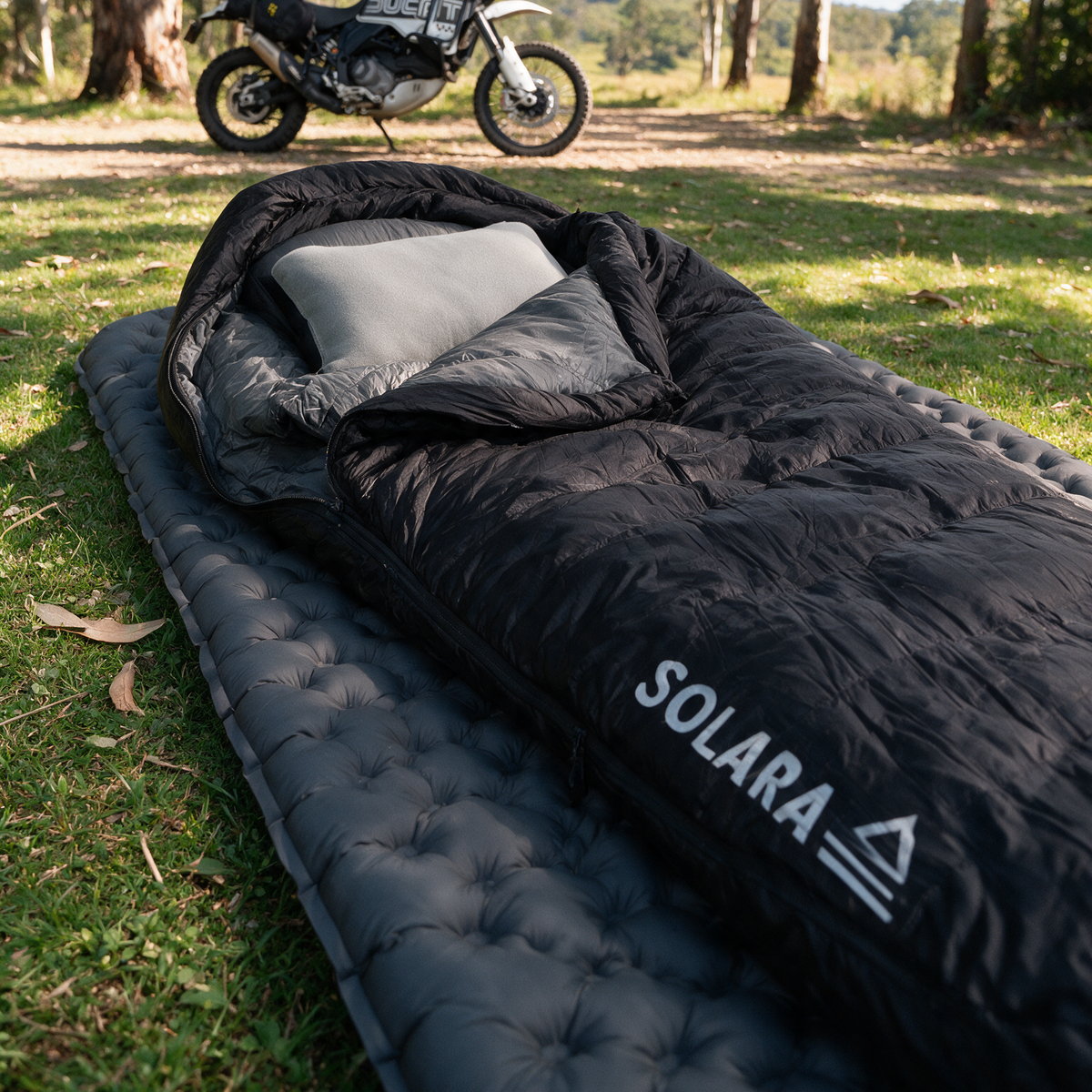
For hikers counting grams and moto campers fighting for pannier space, packed weight and packed size are make-or-break. The Emberline Core comes in at a sub-950g packweight and compresses down small enough to disappear into a pack or a tank bag. This is where high fill power pays off twice — once in warmth, and once in how small the bag squashes down.

Motorcycle and camping gear including a tent, chair, and camping stove on grass.

4. Shell fabric and weather resistance

The shell does two jobs: keep the down contained and keep moisture out. Down loses loft — and therefore warmth — when it gets wet, so a good shell matters enormously. The Emberline Core uses a DWR-treated 20D ripstop shell: lightweight (20 denier), tear-resistant (ripstop weave), and water-repellent (DWR coating) so condensation and light moisture bead off rather than soaking in.

Emberline Core vs the alternatives: full comparison

Here's how the Emberline Core stacks up against the three categories of sleeping bag most people consider when shopping in this space: a typical budget synthetic bag, a premium down competitor (Alton-class), and a flagship international down bag.

Specification Solara Emberline Core Budget Synthetic Bag Premium Down  Flagship International
Fill type 850FP grey goose down Synthetic fill 700–800FP down 850–900FP down
Comfort rating -1°C +5°C (often overstated) 0°C to -2°C -1°C to -5°C
Packed weight Sub-950g 1.2–1.8kg 1-1.2kg 800-950g
Packed size Very compact Bulky Compact Very compact
Shell fabric 20D DWR ripstop 40D+ polyester 20D ripstop 10–15D ripstop
Three-season ready Yes Marginal Yes Yes
Typical price (AUD) $399 $80–150 $450–600 $650–900+

Emberline vs budget synthetic bags

This isn't a close contest on performance. Synthetic bags are cheaper upfront and handle dampness slightly better when fully soaked, but they're dramatically heavier, far bulkier, and lose loft faster over their lifespan. A budget synthetic bag rated "for camping" will typically have a true comfort rating no lower than +5°C, leaving you cold on any genuinely chilly night.

If you camp once a year in summer and weight doesn't matter, a synthetic bag is fine. For anyone hiking, bikepacking, or moto camping with regularity, the Emberline's 850FP down is in a different league — roughly half the weight and a fraction of the packed size for meaningfully better warmth.

Emberline vs premium down competitors (Alton-class)

This is the most relevant comparison for most Solara customers — and the one our own search data shows people actively researching. Alton and similar Australian premium brands make genuinely good down bags, typically in the similar FP range, with comfort ratings around 0°C to -2°C and prices commonly between $450 and $600.

The Emberline Core matches or beats them on the spec that matters most — 850FP fill, higher than most Alton-class bags — while typically coming in 10–20% cheaper. You're getting equal-or-better warmth-to-weight at a lower price. Where established premium brands may still edge ahead is in breadth of range (multiple temperature ratings, women's-specific cuts) and years of brand track record. For a straight value-per-gram-per-dollar comparison, though, the Emberline is hard to beat.

Emberline vs flagship international brands

Flagship bags from the big international names can go even lighter — sometimes ~750g with 900FP fill and ultra-thin 10D shells — and they carry the deepest cold-weather range. But you pay for it: $850 to well over $900. Those gains are marginal for three-season use and mostly matter to gram-obsessed thru-hikers and alpine mountaineers.

For the overwhelming majority of hikers and moto campers operating in three-season conditions, the Emberline delivers 90%+ of the flagship performance at roughly half the price. That's the value proposition in a sentence.

The Emberline Core Sleeping Bag

850FP grey goose down. -1°C comfort. Sub-950g. Built for the trail and the track.

Shop the Emberline Core

Down vs down quilt: which is right for you?

One alternative worth addressing directly, is the down hiking quilt. Quilts ditch the insulation underneath you (where your body weight crushes the down flat) and the full zip, saving weight. They pair with a sleeping mat that provides your underside insulation.

Quilts are lighter and more versatile in warm weather, and ultralight thru-hikers love them. The trade-off: they're draughtier in cold or windy conditions, take some technique to use well, and offer less enclosed warmth than a true mummy bag. The Emberline Core takes the mummy-bag approach precisely because it delivers reliable, draught-free warmth down to -1°C comfortably — better suited to the variable, sometimes cold conditions most Australian and New Zealand adventurers actually face. If you exclusively hike in warm summer conditions and obsess over grams, a quilt may suit you better. For genuine three-season reliability, the enclosed bag wins.

How to choose the best sleeping bag for your adventure

Here's a simple decision framework based on how you actually travel.

  • Weekend hiker, three seasons: An 850FP down bag with a comfort rating around -1°C to 0°C is the sweet spot. The Emberline Core is purpose-built for exactly this.
  • Moto camper / bikepacker: Packed size matters as much as weight. Prioritise high fill power for maximum compressibility — again, 850FP is top-tier.
  • Summer-only car camper: You can get away with a cheaper synthetic bag or a lightweight quilt, since weight and pack size barely matter.
  • Alpine / winter mountaineer: You need a dedicated cold-weather bag with a comfort rating well below -5°C. The Emberline is a three-season bag, not an alpine/snow expedition bag — be honest with yourself about the conditions.

Why fill power and honest ratings matter more than brand

The single most important takeaway from this guide: compare specifications, not logos. A bag's real-world performance is determined by its fill power, its honest comfort rating, its weight, and its shell — not by how recognisable the brand name is or how aggressive its marketing is.

When you strip the comparison back to those numbers, the Emberline Core's position becomes clear. 850 fill power puts it above most premium competitors. Its -1°C comfort rating is quoted honestly to the EN/ISO standard. Its sub-950g weight and DWR ripstop shell are genuinely premium-tier. And it does all of this at a price that is more accessible established down brands, as we sell direct.

Person lying on an inflatable mattress with a sleeping bag, next to a Ducati motorcycle in a grassy area.

Frequently asked questions

What is the best compact sleeping bag for hiking?

The best compact sleeping bag for hiking is one with high fill power down (800FP or above) and an honest three-season comfort rating. High fill power compresses smaller and weighs less for the same warmth. The Solara Emberline Core (850FP, sub-950g, -1°C comfort) is built specifically for this use case and packs down small enough for any backpacking or bikepacking setup.

Is a down sleeping bag better than synthetic?

For weight, packability, and longevity, down is significantly better — an 850FP down bag is roughly half the weight and a fraction of the packed size of a synthetic bag with the same warmth. Synthetic only wins in two narrow cases: lower upfront cost, and retaining some warmth when completely soaked. For most hikers and campers, down is the better long-term choice.

What temperature rating do I need for three-season camping?

For three-season camping in Australia and New Zealand, a comfort rating between 0°C and -5°C covers the vast majority of conditions. The Emberline Core's -1°C comfort rating handles spring, summer, autumn, and mild winter nights. Always check the comfort rating, not the limit or extreme rating, which are quoted optimistically.

How is the Emberline Core different from Alton sleeping bags?

The Emberline Core uses 850 fill power down — higher than most Alton-class bags, which typically sit in the lower FP range — while generally costing 10–20% less. Both are quality Australian-market down bags; the Emberline's edge is a higher warmth-to-weight ratio at a lower price point with almost no marketing fees and no middlemen absorbing your hard-earned money. 

How small does the Emberline Core pack down?

Thanks to its 850 fill power down, the Emberline Core compresses to a very small packed size and weighs under 950g — small enough to fit comfortably in a hiking pack, a bikepacking roll, or motorcycle luggage/tank bag without dominating the space.

Ready to sleep well out there?

The Emberline Core is three-season down performance, built for hikers and moto campers, priced below the premium brands.

Shop the Emberline Core


Latest Stories

This section doesn’t currently include any content. Add content to this section using the sidebar.