
You don't really know your gear until you've been cold in it.

Australian winter moto camping has a reputation problem. "It's only 5°C, we're not in Canada." Then you actually do it, sleeping out somewhere off the highway in the Snowies, the Northern Tablelands, the Vic High Country, the central west of WA, and you find out that 5°C on the BOM forecast is sometimes -2°C at 4am in a frost hollow. The bike doesn't care; you can ride through anything in proper kit. But sleep is where the trip gets won or lost. Cold nights leave you ruined for the ride out, and the ride out is half the reason you're there.

This is the honest guide to staying warm. Not the listicle version. The version we've earned in real cold, on real trips, with real gear failures behind us.

1. Understand what's actually making you cold

Four things move heat out of your body, and each one has a different fix.

Conduction is the big one when you're on the ground. Heat moves from a warm thing (you) to a cold thing (the dirt) by direct contact. The ground in winter is a heat-sink, colder than the air, and it never warms up overnight. This is where most people lose the most warmth without realising it.

Convection is what wind does. Moving air strips warm air away from your skin. This is why a 5°C still night feels fine and a 10°C windy night feels brutal.

Radiation is the one nobody talks about. On a cloudless winter night, your body radiates heat directly up to the open sky, which is effectively at -270°C. This is why you can be warm under tree cover and shivering 30 metres away under open stars on the same night.

Evaporation is sweat. Wet skin loses heat much faster than dry skin. If you ride in, sleep in your day clothes, and they're slightly damp from exertion, you're going to be cold no matter how good your bag is.

The fix for each: better ground insulation, pick your pitch out of the wind, get under cover, and never sleep in damp clothes.

Camping scene with a tent, chair, and camping gear on grass

2. The ground matters as much as the bag

This is the bit that surprises people.

A premium sleeping bag rated to -5°C is wasted if your sleeping mat is rated for summer. The down on the underside of your bag compresses under your bodyweight to almost nothing, so it's not insulating you at all. The only thing between you and a 0°C dirt floor is your mat.

Sleeping mats are rated by R-value, a measurement of how well they resist heat transfer. The scale runs roughly from 1 (a beach mat) to 7+ (winter expedition).

For Australian winter moto camping, here's the rule of thumb:

  • R-value 2–3: Summer only. You'll be cold in autumn.
  • R-value 3–4: Three-season for warm climates. Fine on the coast above 8°C overnight.
  • R-value 4.5–5.5: Real three-season. What you actually want for inland and highland winter trips.
  • R-value 6+: Snow camping territory.

If you've already bought a 3.0 mat and can't justify replacing it, stack a closed-cell foam pad underneath. The R-values add up. A $20 foam pad adds roughly 2.0 R, brings a 3.0 mat to 5.0, and it doubles as a sit-mat at camp. It's the cheapest warmth upgrade you can buy.

Cold spreads. If you're a side sleeper, your hip and shoulder are pressing into the cold spots all night. A higher R-value mat doesn't just keep you warm — it lets you actually sleep.


3. Choose the right sleeping bag, and read the rating properly

Two things matter here: the fill, and the rating.

Fill: down vs synthetic. Down (goose or duck) is unmatched for warmth-to-weight and packed size. Synthetic fills hold their insulation when wet, dry faster, and cost less, but they're heavier, bulkier, and don't last as long.

For moto camping in Australia, down wins for almost everyone, provided you keep it dry. Modern 20D nylon ripstop shells shed light moisture, DWR coatings handle condensation, and a dry-bag liner in your luggage eliminates the rest. The myth of "down is dangerous if it gets wet" was written about expedition mountaineers, not weekend rides.

Fill power is the spec that matters most. It measures how much one ounce of down lofts in cubic inches — basically, how fluffy your fill is. Higher numbers mean more warmth per gram of fill.

  • 600–650FP: Entry level. Heavy and bulky.
  • 700–800FP: Mid-tier. Good bags live here.
  • 850–900FP: Premium. Ultralight performance.

An 850FP bag with 500g of down will be significantly warmer and lighter than a 650FP bag with 500g of down. You're paying for quality of fill, not just quantity.

The rating game. Every sleeping bag has at least two temperature ratings, and the marketing always quotes the lower one:

  • Comfort rating: what you'll actually sleep through.
  • Lower-limit rating: what you'll survive in if you curl up and shiver.

If a bag is marketed as "0°C," that's usually the lower-limit. Add 5–6°C for the realistic comfort temperature. The Emberline Core is rated -1°C at the comfort number, which is the genuine "sleep through it" rating for Australian three-season conditions.

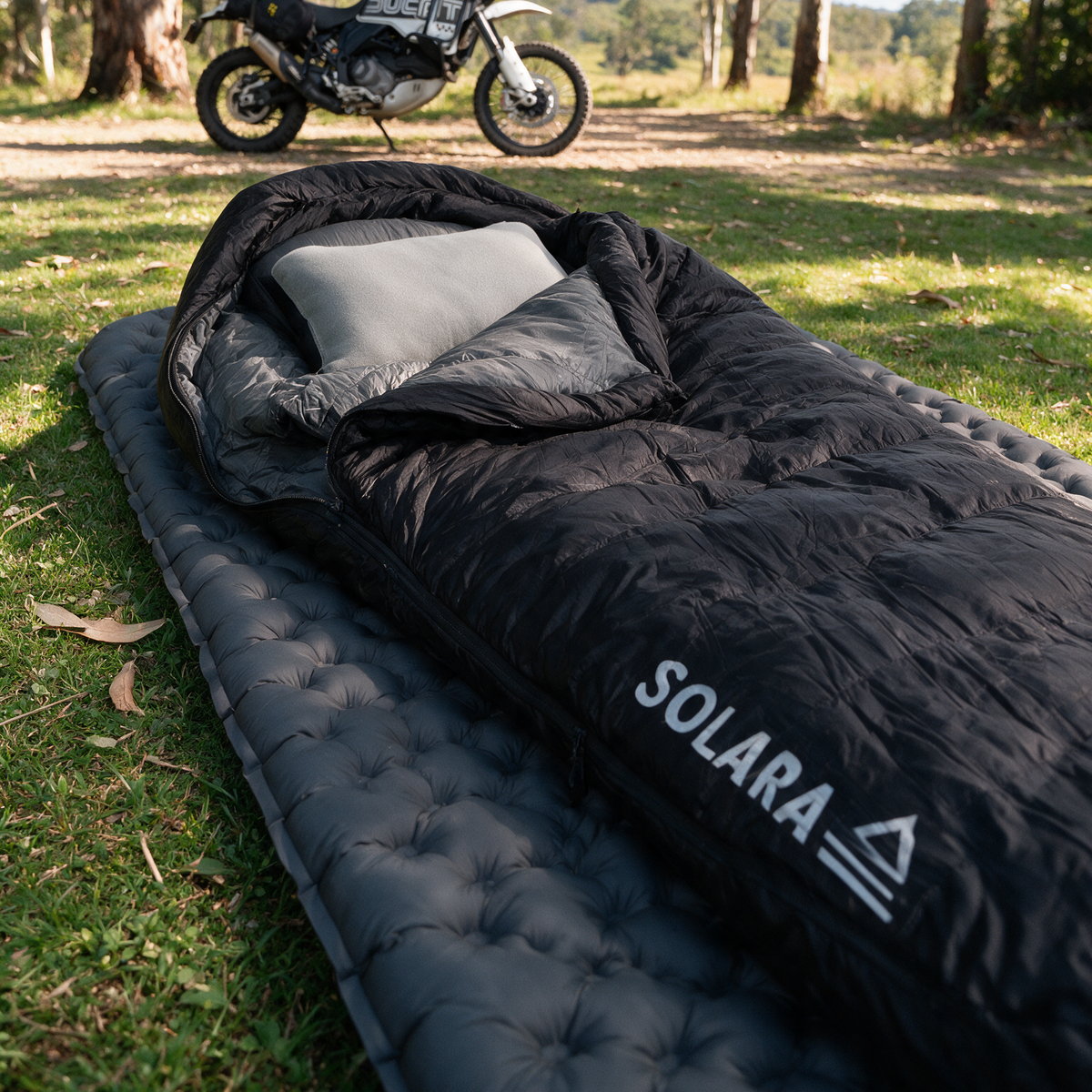
Motorcycle and sleeping bag on grass

4. Layering before you sleep

Three rules:

Never sleep in what you wore today. Even if you don't feel sweaty, you are. Body moisture trapped against your skin will cool you down for hours. Have a dedicated set of sleep clothes — merino base layer top and bottom, fresh socks, a beanie — that lives in your sleep-system dry bag and never sees daylight on the ride.

A beanie is non-negotiable. You lose a serious amount of heat through your head and neck. A 50g merino beanie is the single highest warmth-per-gram item in your kit. Wear it to bed. Sleep in it. If you wake up cold, pull it down further.

Layer inside the bag for cold nights. If the temperature is at the edge of your bag's rating, sleep in your puffy jacket inside the bag. The puffy adds another insulation layer and gives the bag more headroom for the body warmth it's holding in.

Don't overdo it though — too many layers compress the bag's loft from the inside and reduce its insulating power. One mid-weight base layer, beanie, dry socks, and the puffy if needed. That's the system.

5. Pre-sleep warm-up tricks that actually work

Getting into a cold bag when you're already cold is rough. The bag doesn't generate heat, it traps the heat you make. If you're already cold getting in, you'll stay cold for hours.

Five things that work:

Eat something fatty 30 minutes before bed. Your body burns calories all night to stay warm, and fat burns slower than sugar. A handful of nuts, some cheese, or a chocolate bar does more for overnight warmth than people realise.

Drink something warm, not hot. Scalding hot drinks make you sweat for the first 20 minutes after you finish them. Warm tea or a mild miso is better than boiling cocoa right before bed.

Hot water bottle at the foot of the bag. Boil water, fill your titanium bottle (the Solara 750ml is fire-safe and rated for boiling water; most plastic bottles aren't), wrap it in a sock, and stick it inside your sleeping bag at your feet 15 minutes before you get in. Pre-warms the bag, stays warm for hours, and doubles as the first kettle once you wake up.

Empty your bladder. A full bladder makes your body work harder to maintain core temperature overnight, because urine sits at body temperature and your body keeps it that way. Last toilet trip, every time, no exceptions.

6. Pitch the tent for warmth

Where you pitch matters as much as what you pitch.

Avoid the bottom of valleys and creek beds. Cold air sinks. The temperature on a valley floor can be 5°C colder than the slope 30m above it, every single night. Look for slight elevation, a flat spot on a gentle rise is the sweet spot.

Use natural windbreaks. A line of trees, a rock outcrop, an embankment, even partial shelter from the prevailing wind drops the effective temperature significantly. Check the forecast for wind direction before you pick the spot.

Get under tree cover if the sky is clear. Radiation cooling is brutal on cloudless nights. Trees overhead bounce some of your radiated heat back. A pitch under a gum can be 2–3°C warmer than the same pitch 5m away in the open.

Pitch the fly tight. A loose, flapping fly traps less warm air around the tent and lets condensation drip back onto you. Tension every guy line. The Waypoint 1P uses a single trekking-pole geometry that pulls tight in seconds, most modern lightweight tents are similar. Don't half-pitch a tent in winter.

Vestibule for boots and gear. Wet riding boots inside the tent will fog and freeze everything overnight. They live in the vestibule, upside down on a stick or rock to drain, with the laces inside so they don't freeze rigid by morning.

7. The morning is half the trick

A bad morning ruins a good night.

Sleep with tomorrow's base layer inside the bag. Pulling on a cold base layer at 5am in a 0°C tent is the worst part of winter camping. Stuff tomorrow's clothes into the foot of your bag overnight — they'll be warm when you put them on.

Boots in the vestibule, upside down. If it's really cold, the boots' inner liners go inside the sleeping bag overnight in a stuff sack at the foot. Frozen boot liners at 6am is a special kind of suffering.

Kettle before clothes. Get the stove going from inside the bag. A warm drink in hand changes your relationship with the morning. The flatpack stove and titanium mug are sitting next to you for exactly this reason.

Layer down slowly. Don't strip off layers the second you stand up. Keep the beanie on through coffee, peel down as the sun warms up, ride in your real layers once you're moving.

What it actually feels like when you get it right

Cold mornings stop being something you endure and start being something you look forward to. You wake up warm, with a bag full of dry clothes, a bottle that's still mildly warm at your feet, and a stove arm's-reach away. You boil water without leaving the bag. You take ten minutes drinking it. You pack down at your own pace, and by the time you're on the bike the frost is lifting and you're ready for the day.

That's the goal. Gear is just the means.

Build your system once, set it up properly, and Australian winter moto camping turns from a test of endurance into a reason you bought the bike in the first place.


Got a setup that works for you? Tag us on Instagram @solaraoutdoors  we read every trip post, and the best ones end up in the next guide.

Latest Stories

This section doesn’t currently include any content. Add content to this section using the sidebar.